

Red Light, Green Light
Six games. Six rule sets. Zero coordination. One person to track it all.
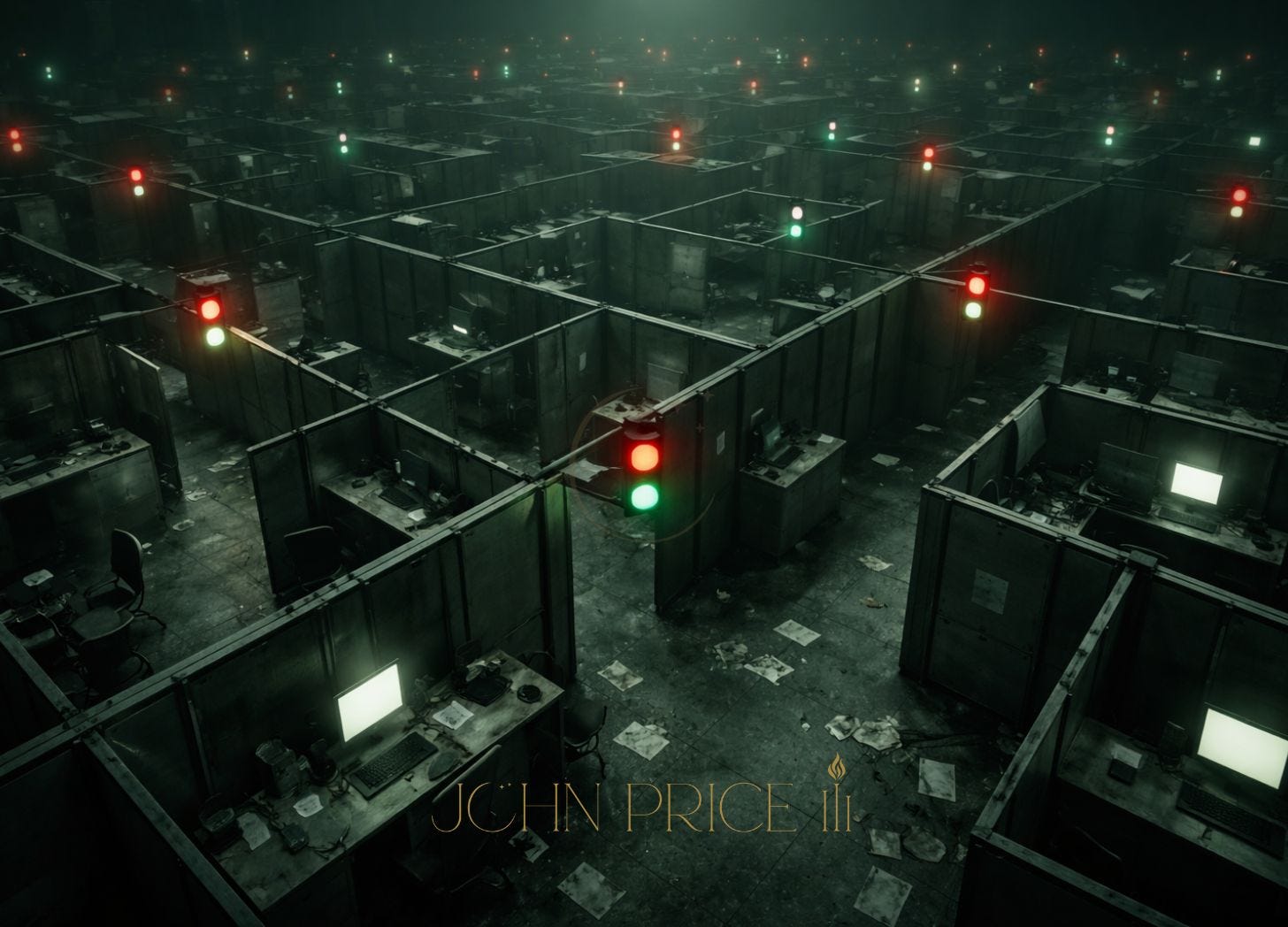
Do you remember the kids game, “Red Light, Green Light”?
One person stands a short ways away and they are “the light.” A group of kids all stand at the same starting line. When “the light” is facing away from you, it’s a green light and you get to move forward. When the light turns around, they shout “Red Light!” and you have to immediately freeze—no movement, or you’re out.
Well, guess what? You’re still playing that game and you didn’t even know it.
Every day you go to the office, you’re playing the corporate version of Red Light, Green Light.
Except you’re not playing one game—you’re playing six at once.
Bob’s light says green. Susan’s says red. The client’s is flashing. Your manager’s hasn’t turned on yet. And if you move at the wrong time for the wrong person? You’re out.
Welcome to corporate, where success isn’t about doing good work—it’s about remembering which invisible rulebook applies to which stakeholder at which moment.
What the Game Actually Looks Like
Bob the ________(fill in the title/role of your choice) wants:
Status updates in format A
Delivered every Tuesday by 3pm
No team messages—he’ll book meetings
Updates sent via Slack DM
Susan (who plays the same role as Bob) wants:
Status updates in a completely different format
Tracked in Confluence, not email
Backup documentation attached
Delivered Thursdays by EOD
She won’t deliver the report herself—you send it to leadership
All communication via email, never Slack
Your client wants:
Weekly summaries in PowerPoint
Delivered Fridays before noon
CC’d to three people (but never mention the fourth)
Only “high-level,” no details
Your manager wants:
Real-time updates when asked
But also hates being “bothered”
Prefers verbal check-ins
Unless she’s busy, then email
You’re supposed to know which
The expectation?
Track all of it. Execute flawlessly. Switch contexts seamlessly. Don’t mix them up. Don’t ask for clarification—you should “just know.”
Make a mistake? Then you’re the problem.
How This Hits Empaths
If you’re an empath, this isn’t just annoying—it’s cognitively and emotionally exhausting.
Because empaths don’t just track preferences. We track:
The emotional state of each person
Their communication style
Their triggers
Their unspoken expectations
The relational cost of getting it wrong
This means that we are forced to bear the burden of tracking who wants what format by when in which system in what tone and style and how they’ll react if we don’t deliver it just so.
This is not “attention to detail.”
This is unsustainable cognitive load disguised as competence.
The game isn’t hard because the rules are complex.
The game is hard because there are multiple simultaneous rule sets, none of them written down, and the consequences of mixing them up are treated as your failure—not a system design flaw.
Why This Happens
Most people aren’t trying to make your life harder.
They’re optimizing for their workflow.
Bob likes Slack because it’s fast
Susan likes email because she needs a paper trail
The client likes PowerPoint because leadership does
Your manager doesn’t want to be “micromanaging”
Each person creates a system that works for them—without considering that you’re the node connecting all of them.
Rarely does anyone ask:
“Is this sustainable for the person executing it?”
“Are we creating conflicting expectations?”
“Should we standardize anything?”
The system assumes you’ll absorb the complexity, and that you, the big hearted empath will just... figure it out.
Tiny Tools for Tiny Spaces
When you’re playing too many Red Light, Green Light games at once, here’s what helps:
Somatic Reset:
Notice where you’re holding tension (jaw, shoulders, chest).
Place one hand on your heart.
Inhale for four counts. Hold for two. Exhale for six.
Repeat three times.
Remind yourself: I’m doing the best I can with an impossible system.
Boundary Phrase:
(Internal mantra)
“I’m not responsible for reconciling everyone’s conflicting preferences.”
Clarity Question:
“Is this failure actually mine, or is this the natural result of managing too many uncoordinated rule sets?”
Prevention Tool:
Create a simple tracking document (for you, not them):

This isn’t you being “high-maintenance.”
This is you managing a system no one else is coordinating.
Advanced Tiny Tool for Big Empaths:
When the preferences conflict and you’re caught in the middle, you have options:
Option 1: Ask them to coordinate
“I want to make sure I’m meeting everyone’s needs. Right now, Bob prefers X and Susan prefers Y. Can we align on one approach, or should I continue managing both separately?”
Option 2: Standardize at your end
“Bob and Susan, you are both asking for the same information but in formats that are specific to your preferences. I will post all the information you need here in this format. That way you can adapt it as needed.”
Why this is advanced:
You’re naming the system issue without blaming anyone.
You’re either asking leadership to coordinate what they’ve left uncoordinated, or you’re taking control of what’s within your power to standardize.
You’re revealing that the complexity isn’t invisible—it’s just unacknowledged.
Sometimes they’ll coordinate. Sometimes they won’t.
Either way, you’ve made the cognitive load visible instead of silently absorbing it.
The boundary is this:
You can execute multiple workflows. What you can’t do is read minds, predict shifting preferences, or be punished for not intuitively knowing which game you’re in at any given moment.
The Truth Underneath
You’re not “bad at following instructions.”
You’re not “too detail-oriented.”
You’re not “overthinking it.”
You’re playing the game and trying to manage an inherently unmanageable system—and likely doing it remarkably well.
The fact that you can track this many personalized rule sets simultaneously?
That’s not a baseline expectation. That’s a skill.
Please remember this, the source of the problem isn’t you.
The problem is that empaths are so good at absorbing complexity that no one notices how much we’re carrying.
Next time you feel frozen mid-step, remember: the lights aren’t just inconsistent. There are too many of them—and that’s a system design flaw, not yours.
Now it’s your turn.
Which part of this resonated most? Leave a comment—I read them all.
Know an empath who needs this?
Hit the share button. They’ll thank you later.
Subscribe to Big Empaths, Tiny Spaces to get new posts delivered straight to your inbox—because navigating corporate chaos is easier when you’re not doing it alone.